



Customer Pickup Safety Guide
How to safely collect and transport your steel products when picking up in a car, ute, van, light truck or trailer (GVM up to 4.5 tonnes).
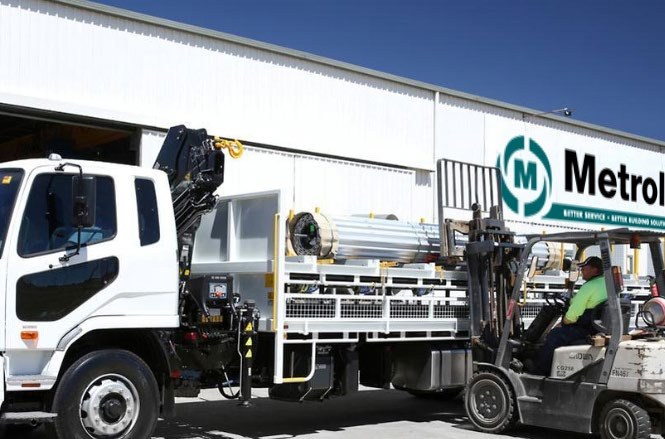
3 m
Minimum exclusion zone while loading
40 / 100 kg
Roof-rack limit: cars & vans / utes with trade racks
2 + 1 per 1.5 m
Minimum lashings per stack
12.5 m
Maximum vehicle and product length
About this guide
This guide sets out the safety requirements for customers collecting products from ClickSteel sites. It applies to products collected using cars, utes, vans, light trucks and trailers with a Gross Vehicle Mass (GVM) of up to 4.5 tonnes.
Customers are responsible for ensuring their vehicle and any trailer are suitable for the products being collected, that the load is within applicable mass and dimension limits, and that all products are adequately secured before travelling on public roads.
Read this guide together with your state and territory road rules and the National Transport Commission’s (NTC) Load Restraint Guide for Light Vehicles.
Unsure if your load is safe?
Check with ClickSteel personnel before leaving site. Loading staff may refuse to load any vehicle, trailer or restraint setup that is unsuitable or unsafe.
01
Site requirements
Wear the required PPE
Each site has its own PPE requirements. PPE may be loaned for the collection and must be returned before you leave.
Stay with your vehicle
Remain with your vehicle and follow all instructions from ClickSteel loading personnel.
Never climb on loads
Don’t climb onto vehicles, loads or roof racks to secure products. Use suitable equipment and site-approved arrangements.
Follow site traffic rules
Observe all site speed limits, traffic signs and directions.
Loading may be refused
Staff may refuse to load an unsuitable or unsafe vehicle, trailer, load arrangement or restraint. Alternative delivery may be available and may incur a fee.
In an emergency
Stay within the designated customer pick-up area where safe to do so and wait for instructions from ClickSteel staff.
02
Chain of responsibility (CoR)
Under chain of responsibility laws, everyone who has control or influence over the transport task is responsible for complying with the law. For more information visit the National Transport Commission or contact your local state road and transport authority.
Any party who has control in a transport operation can be held responsible and may be legally liable.
Customer responsibilities
- Select a vehicle and trailer suitable for the products being collected.
- Make sure vehicle and trailer loads don’t exceed rated carrying capacities.
- Make sure products are adequately supported and restrained.
- Make sure the load doesn’t block your vision, lights, indicators, reflectors or number plate.
- Check the load is secure before departure and during the journey.
- Comply with road rules and Metroll site requirements.
ClickSteel/ loader responsibilities
- Make sure products are appropriately packaged.
- Make sure products are within the vehicle’s legal mass and dimension limits.
- Follow site loading and safety procedures.
- Guide the customer where needed so adequate load restraints are applied.
- Refuse to load vehicles or combinations considered unsuitable or unsafe.
- Keep customers in designated safe zones at all times while loading.
03
Loading exclusion zones
- Stay in the designated safety area while products are loaded by crane or forklift. Don’t enter the exclusion zone until loading personnel give permission.
- Where lightweight products are hand-loaded, you may stay with your vehicle if Metroll personnel permit it and it is safe to do so.
- Follow all instructions from loading personnel during loading.
The exclusion zone applies to every pickup vehicle: cars, utes, vans, trucks and trailers.
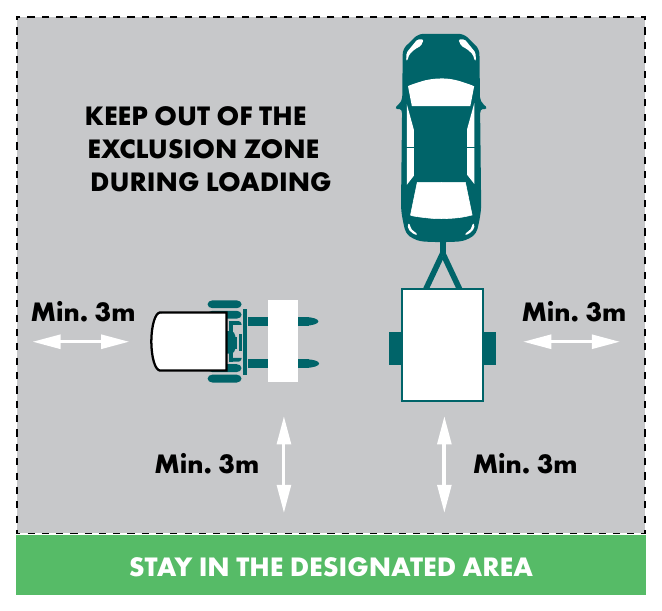
Keep a minimum of 3 m clear of the vehicle on all sides during loading.
04
Vehicle load requirements
Roof racks & vehicle load capacity
- Vehicles must not be overloaded.
- Make sure the vehicle and roof rack are approved and rated to carry the intended load.
- Check the vehicle manufacturer’s roof load limit and the roof rack manufacturer’s rated capacity.
- The combined load must not exceed the lowest applicable rated capacity.
- Allow for the weight of the products, supports and any other equipment carried.
- Don’t carry products on an unsuitable or unverified roof rack.
Without written verification of rack and vehicle limits, safe loading limits are:
40 kg
Sedans, vans & wagons
100 kg
Utes with trade
racks
Flexible & long product loading
- Support and secure long or flexible products to prevent bending, movement or loss.
- Use a vehicle or trailer of sufficient length with suitable support.
- Make sure the load doesn’t obstruct the driver’s vision.
- Secure products at appropriate points along their length.
- Prevent movement at both the front and rear of the load.
- Don’t transport products that extend beyond permitted dimensions or can’t be safely restrained.
Overhang requirements
- Any projecting load must comply with state and territory road rules.
- Loads must not obstruct the driver’s vision or endanger other road users.
- Loads must not hide lights, indicators, reflectors or number plates.
- Where required, projecting loads must show a brightly coloured flag (min. 300 mm square) by day or a red light at night.
- Overall vehicle and load dimensions must comply with applicable requirements.
05
Rigid product loading
W = wheelbase. Rear overhang is measured from the centre of the rear axle. All dimensions in mm.
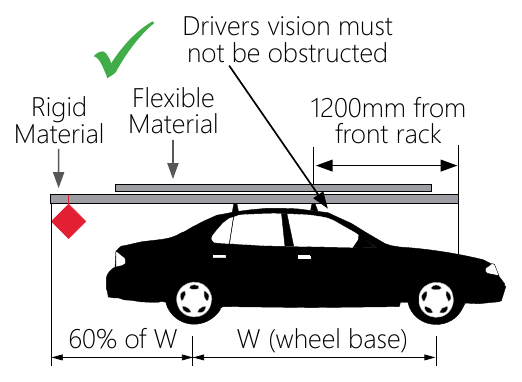
Cars: max. 1200 mm past the front rack, rear overhang up to 60% of W. Driver’s vision must not be obstructed.
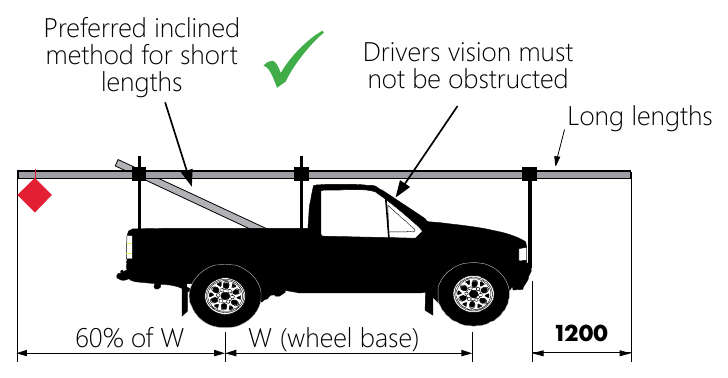
Utes: inclined is the preferred method for short lengths. Long lengths on the rack, max. 1200 mm forward.
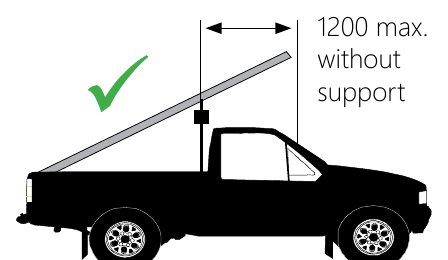
Inclined loads may extend a maximum of 1200 mm without support.
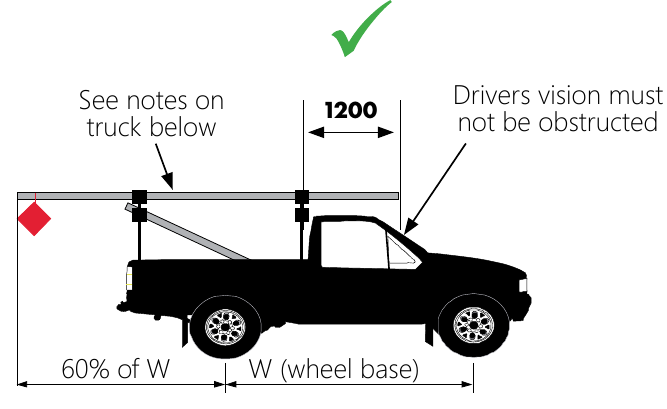
Rack and tray combination: 1200 mm max. forward, rear overhang 60% of W.
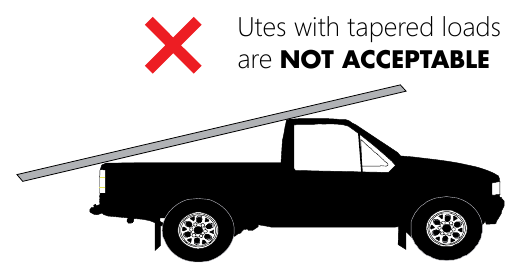
Utes with tapered loads are not acceptable.
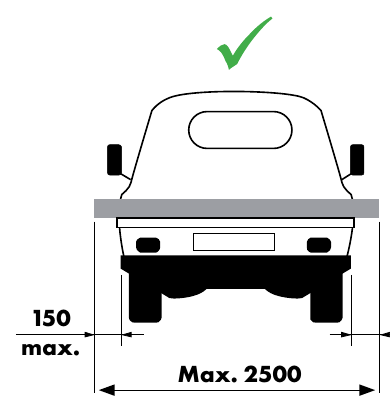
Max. width 2500 mm; side projection max. 150 mm each side.
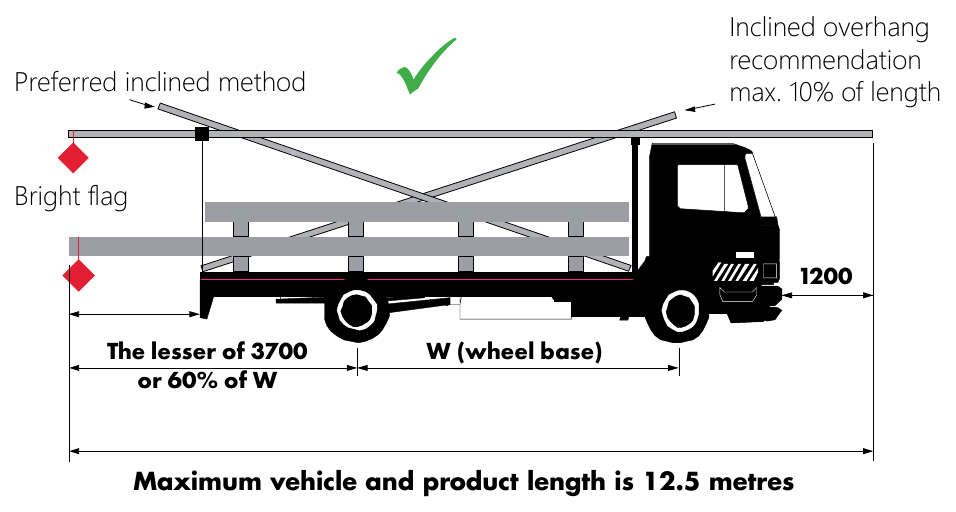
Light trucks
- Rear overhang: the lesser of 3700 mm or 60% of W.
- Inclined is the preferred method; inclined overhang recommended max. 10% of length.
- Max. 1200 mm forward projection.
- Display a bright flag on projecting loads.
- Maximum vehicle and product length is 12.5 m.
06
Trailer product loading
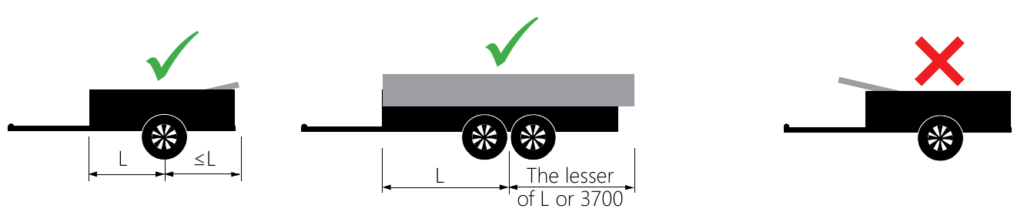
Rear overhang must be the lesser of the load area ahead of the centre of the axle group (L) and 3700 mm.
No forward overhangs for box trailers
Roof racks & vehicle load capacity
- Vehicles must not be overloaded.
- Make sure the vehicle and roof rack are approved and rated to carry the intended load.
- Check the vehicle manufacturer’s roof load limit and the roof rack manufacturer’s rated capacity.
- The combined load must not exceed the lowest applicable rated capacity.
- Allow for the weight of the products, supports and any other equipment carried.
- Don’t carry products on an unsuitable or unverified roof rack.
Without written verification of rack and vehicle limits, safe loading limits are:
40 kg
Sedans, vans & wagons
100 kg
Utes with trade
racks
When carrying products on a trailer, make sure:
- The trailer suits the product’s weight, length and dimensions.
- The trailer’s rated carrying capacity isn’t exceeded.
- The load is evenly distributed with a low centre of gravity.
- Products are supported and restrained to prevent movement.
- The towing vehicle’s towing capacity and load limits aren’t exceeded.
- The coupling and safety chains are correctly connected.
- Lights, indicators, reflectors and number plates stay visible.
- Any projecting load complies with road rules.
NOTE
Towing a trailer doesn’t automatically allow you to carry a longer or heavier load. The towing vehicle, trailer, combined mass and load projections must all comply.
Check before you tow
Trailer capacities and permitted load dimensions vary. Check the manufacturer’s specifications and your state or territory road rules.
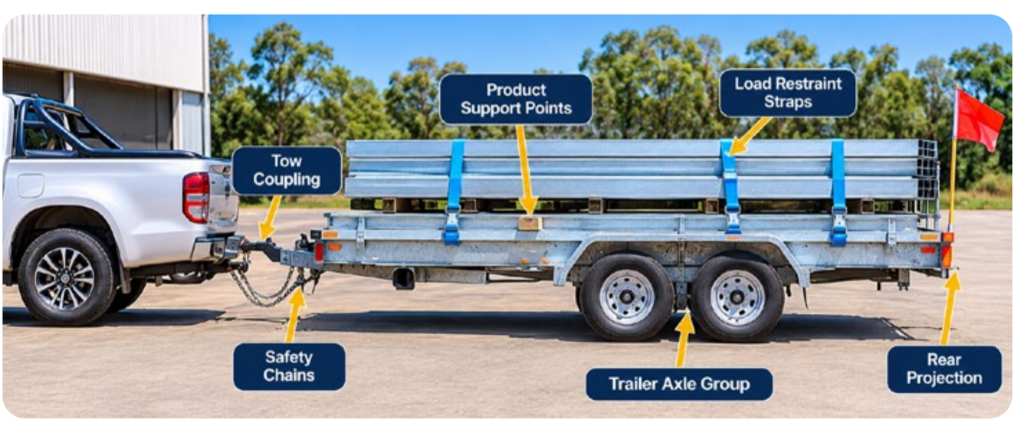
A correctly loaded trailer: tow coupling, safety chains, support points, restraint straps and a flagged rear projection.
07
Load restraint requirements
General load restraint
- Restrain all products so they can’t move or fall during braking, acceleration and cornering.
- The load must not affect the vehicle’s stability, steering or braking, or put anyone at risk.
Restraint equipment
- Minimum 2 lashings per stack and 1 lashing per 1.5 m along the load.
- Use rated restraint equipment in good condition, attached to appropriate anchor points.
- Check for cuts, fraying, damage, corrosion or worn fittings before use.
- Protect straps from sharp edges.
- Restrain against forward, rearward, sideways and upward movement.
- Recheck the load before departure and during the journey.
Utes & trailers
- Keep the load stable with a low centre of gravity.
- Separately restrain heavy or unstable items. Don’t rely on tray or trailer sides alone.
Steel-on-steel contact
- Avoid direct steel-on-steel contact that may let products slide.
- Use timber dunnage, rubber matting or other packing to add friction and protect products, positioned so it doesn’t destabilise the load.
Prohibited: occy straps & flexi straps
These must never be used to secure Metroll products.
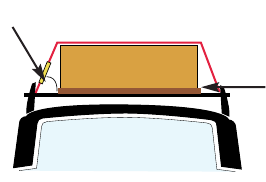
Check the lashing angle: the more upright, the more secure. Timber fixed to the roof rack adds friction under the product.
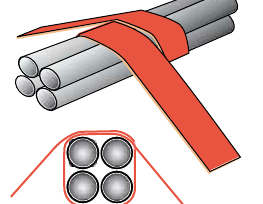
Round products: restrain against rolling and sliding. Belly-wrap and add extra restraints or blocking to prevent spearing.
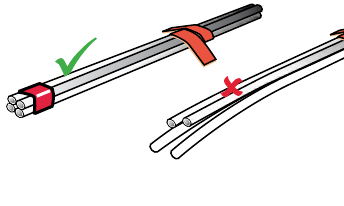
Never leave extended loads loose. Always secure the ends, front and back.
Table 1: Maximum mass per lashing
| Lashing angle to horizontal | Hand-tight webbing | 10–12 mm rope (synthetic)* | 25 mm ratchet webbing | 35 mm ratchet webbing | 50mm ratchet webbing |
|---|---|---|---|---|---|
60° to 90° |
52 kg |
85 kg |
170 kg |
430 kg |
510 kg |
45° to 60° |
46 kg |
70 kg |
140 kg |
350 kg |
420 kg |
30° to 45° |
30 kg |
50 kg |
100 kg |
250 kg |
300 kg |
15° to 30° |
15 kg |
25 kg |
52 kg |
130 kg |
150 kg |
* Single high capacity. Non-preferred lashing type.
Before leaving site
Check your load
If you’re unsure whether your load is safe, check with Metroll personnel before leaving site.
References
National Transport Commission: Load Restraint Guide for Light Vehicles
Your state or territory road authority