





“Is Your Roof Actually Built for the Coast Or Just Holding On?“
Living within a few kilometres of the ocean is one of the best lifestyle decisions you can make in Australia. But that sea breeze carries a hidden cost. Salt air is relentless. It settles on every surface, works into every joint and fastener, and quietly accelerates corrosion in ways that most homeowners don’t notice until the damage is already expensive.
The wrong roofing material near the coast doesn’t just look tired faster. It fails faster. And replacing a roof on a beachside property in Queensland, NSW, or WA is not a weekend job.
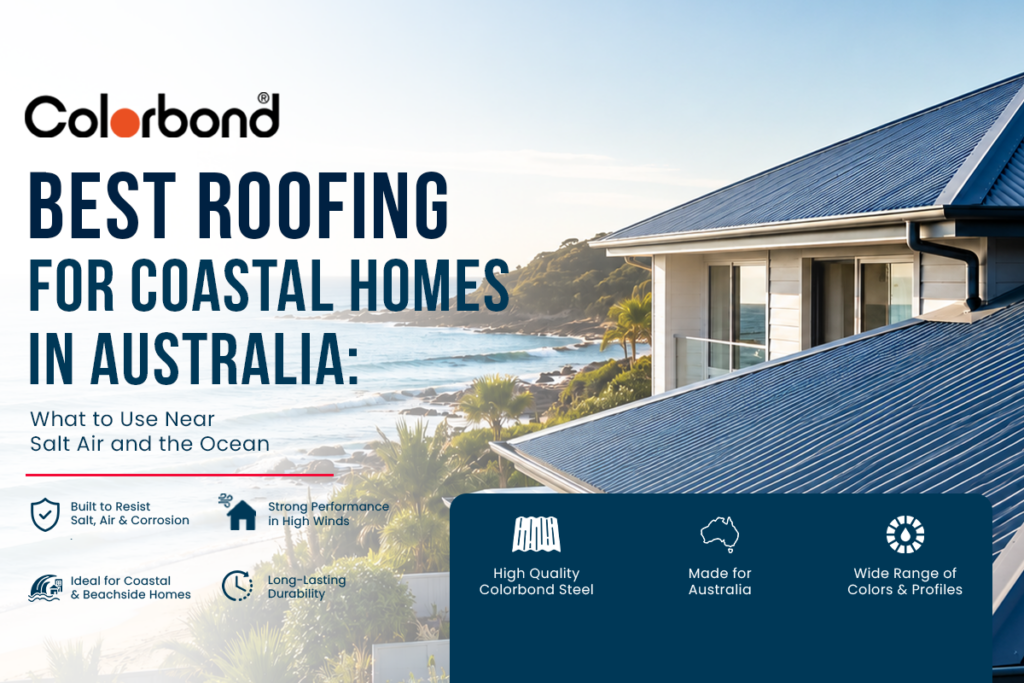
The best roofing for coastal homes in Australia is COLORBOND® steel, specifically products rated for marine and near-marine environments. Paired with the right profile, correct fasteners, and a basic maintenance routine, it can outlast almost any other roofing material in salt air conditions.
Here is what you need to know before you buy, build, or renovate near the water.
What Does Salt Air Actually Do to a Roof?
Salt particles in coastal air are tiny, airborne, and carry an electrochemical charge that speeds up metal oxidation. The closer your home is to the ocean, the higher the salt load. Properties within 200 metres of breaking surf are in the most aggressive category.
Uncoated steel rusts quickly. Galvanised steel performs better but still degrades over time in severe marine zones. Even some painted finishes can blister and lift if the underlying substrate isn’t rated for salt air exposure.
The result? Corroding fasteners, stained ceilings, flaking paint, and structural weakness in the roof sheeting itself. Catching it early saves thousands. Choosing the right material upfront saves even more.
Coastal Roofing Materials Compared
| Material | Salt Air Suitability | Typical Lifespan (Coastal) | Notes |
|---|---|---|---|
COLORBOND® steel (standard) |
Good (>500m from ocean) |
30–40 years |
Best value for most coastal homes |
COLORBOND® Ultra steel |
Excellent (near-marine) |
40+ years |
Designed for high-corrosion zones |
ZINCALUME® steel (uncoated) |
Moderate |
20–30 years |
Not ideal within 100m of surf |
Aluminium |
Very Good |
30–40 years |
Lightweight, no rust, higher cost |
Concrete tile |
Poor |
15–25 years |
Absorbs salt, heavy, prone to crack |
Terracotta tile |
Poor–Moderate |
20–30 years |
Better than concrete but limited life |
Zinc standing seam |
Excellent |
50+ years |
Premium cost, very high performance |
For the vast majority of Australian beachside properties, COLORBOND® roofing is the practical first choice. It covers the performance requirements for most coastal classifications without the premium cost of zinc or aluminium.
Is COLORBOND® Good for Coastal Homes?
Yes, and specifically COLORBOND® Ultra steel for the most aggressive marine environments.
Standard COLORBOND® steel is suitable for properties roughly 200–500 metres or more from the coast. For homes closer to the water, within 100 to 200 metres of breaking surf in places like the Gold Coast, Manly, Cottesloe, or Noosa, COLORBOND® Ultra is the recommended specification. It uses a higher-grade substrate with improved corrosion resistance developed and tested in Australian coastal conditions.
Both variants carry the same colour range and profile options, so you don’t sacrifice aesthetics for performance.
Coastal Roofing Lifespan and Maintenance at a Glance
Here’s a quick breakdown of how different coastal roofing materials perform based on ocean proximity, expected lifespan, and ongoing maintenance requirements.
- COLORBOND® Ultra steel
- COLORBOND® standard steel
- COLORBOND® standard steel
- Aluminium sheeting
- Zinc standing seam
- Concrete tile
Distance from Ocean:
0–200m
Expected Lifespan:
40+ years
Maintenance Frequency:
6-monthly wash down
Distance from Ocean:
200–500m
Expected Lifespan:
30–40 years
Maintenance Frequency:
Annual wash down
Distance from Ocean:
500m+
Expected Lifespan:
35–45 years
Maintenance Frequency:
Every 18–24 months
Distance from Ocean:
0–300m
Expected Lifespan:
30–40 years
Maintenance Frequency:
Annual inspection
Distance from Ocean:
Any coastal zone
Expected Lifespan:
50+ years
Maintenance Frequency:
Minimal, periodic check
Distance from Ocean:
500m+ only
Expected Lifespan:
15–25 years
Maintenance Frequency:
Frequent sealing required
What Roofing Profile Works Best Near the Ocean?
Corrugated roofing is the proven performer. The rounded profile sheds water cleanly, has fewer standing water traps, and has been used on Australian coastal homes for over a century. COLORBOND® corrugated roof sheets remain the most common choice for beach house roofing across Queensland and NSW.
Corrugated roofing
Australia’s harsh light is unforgiving on lighter colours, which can look washed out under direct sun. Monument holds its depth in bright light, it reads as intentional and sharp even under full Queensland sun or a clear Western Australian sky.
Concealed-fix profiles
Concealed-fix profiles like METLOK also work well for coastal homes, there are no exposed fasteners to corrode. COLORBOND® METLOK concealed-fix roofing is worth considering for new builds or full re-roofs close to the waterline.
For high-wind coastal zones, common in Far North Queensland, WA’s Pilbara coast, and cyclone-rated areas, make sure your installer specifies cyclonic assemblies and compliant fastening patterns.
Best COLORBOND Colours for Coastal Homes
Colour isn’t just aesthetic on a coastal roof, it affects heat load, which impacts how quickly moisture cycles through the roof system.
Lighter colours reflect more heat, which generally suits tropical and subtropical coastal climates. Darker colours absorb heat but can increase attic temperatures in summer without adequate insulation.
Popular coastal colour choices include:
- Surfmist®: A warm off-white that suits beach-house styles and reflects heat well
- Paperbark®: A sandy neutral that blends naturally with coastal landscapes.
- Dune®: Warm beige, low-key, suits weatherboard and rendered homes alike.
- Shale Grey®: Popular on contemporary coastal builds in NSW and WA
To browse the full COLORBOND® colour range for roofing, visit the COLORBOND® roofing colours page.
Need Custom Flashings?
Use our state of the art Flashings Designer
Design, Order, Delivered
Gutters, Flashings, and Fasteners: The Details That Matter Most
A well-specified roof sheet is only part of the picture. In salty environments, the accessories are where corrosion problems usually start.
Gutters & Fascia
Use COLORBOND® steel gutters and fascia in matching or complementary colours. The same corrosion-resistant substrate protects them under salt load. Explore the COLORBOND® fascia and gutter range for options suited to your home.
Flashings
All penetrations — ridges, valleys, barge ends, need properly specified flashings. Generic galvanised flashings are a common weak point. ClickSteel’s custom flashing designer lets you order exactly what you need.
Fasteners
This is where many coastal roofs fail first. Stainless steel or Class 4 coated fasteners are the minimum requirement near the ocean. Standard zinc-plated screws will rust quickly and leave brown staining down your roof sheeting.
Roof Insulation in Coastal Climates
Coastal homes deal with humidity as much as heat. The right insulation under your roof sheets helps manage condensation, which can accelerate corrosion from the underside if left unchecked.
Sarking and reflective foil insulation are standard for coastal homes in Queensland and the tropical north. In NSW and WA beach suburbs, bulk insulation combined with ventilation baffles helps manage moisture cycling.
COLORBOND® insulation products are worth specifying at the same time as your roof sheets, rather than trying to retrofit later.
Common Mistakes Coastal Homeowners Make
Even high quality roofing can fail early in coastal areas if the wrong materials, fixings, or maintenance habits are used. Here are some of the most common mistakes that shorten the lifespan of coastal roofs.
Gutters, Fascia and Flashings in Monument
- Using standard galvanised fasteners instead of stainless steel.
- Skipping the wash-down routine — even once a year makes a significant difference.
- Choosing the wrong COLORBOND® grade for the actual distance to the ocean.
- Leaving debris in gutters — salt-laden organic buildup accelerates corrosion fast.
- Ignoring flashing details on penetrations and valley junctions.
- Not checking compatibility between materials, some flashings and roof sheet combinations create galvanic corrosion.
The Bottom Line
Coastal roofing isn’t complicated, but it does require the right specification from the start. Choose COLORBOND® Ultra for the most exposed positions. Use stainless fasteners throughout. Match your gutters, flashings, and fascia to the same corrosion-resistant standard. Wash it down twice a year.
A beach house roof done right doesn’t need to be touched for decades. Done wrong, it starts showing the strain within a few wet seasons.
If you’re ready to spec your coastal roof, browse the full COLORBOND® roofing range at ClickSteel, cut to length, priced online, and delivered across Australia.
Frequently Asked Questions
COLORBOND® steel, and specifically COLORBOND® Ultra steel for homes within 200 metres of the ocean, is the best all-round choice for Australian coastal roofing. It combines corrosion resistance, wind performance, and a wide colour range in a single product designed for Australian conditions.
BlueScope recommends COLORBOND® Ultra steel for severe marine environments, generally defined as within roughly 100 to 200 metres of breaking surf or saline water. For homes further back, standard COLORBOND® is appropriate with regular maintenance.
No. COLORBOND® products carry warranties applicable to coastal environments, provided the correct grade is specified for the distance to the ocean and the installation meets the required standards. Always confirm with your supplier or builder.
For homes within 200 metres of the coast, a wash-down every six months with fresh water is ideal. A mild detergent solution can be used for heavier salt deposits. Avoid high-pressure washing directly at laps and fasteners.
Aluminium won’t rust, which gives it a performance advantage in the most aggressive marine environments. However, it is more expensive, softer and prone to denting, and carries a narrower colour range. COLORBOND® Ultra steel offers comparable longevity at a more accessible price point for most homeowners.